

Exposition - Exhibition
Leonora Carrington
At the crossroads of surrealism, mythology and esotericism
Until July 19, 2026
Musée du Luxembourg - Paris
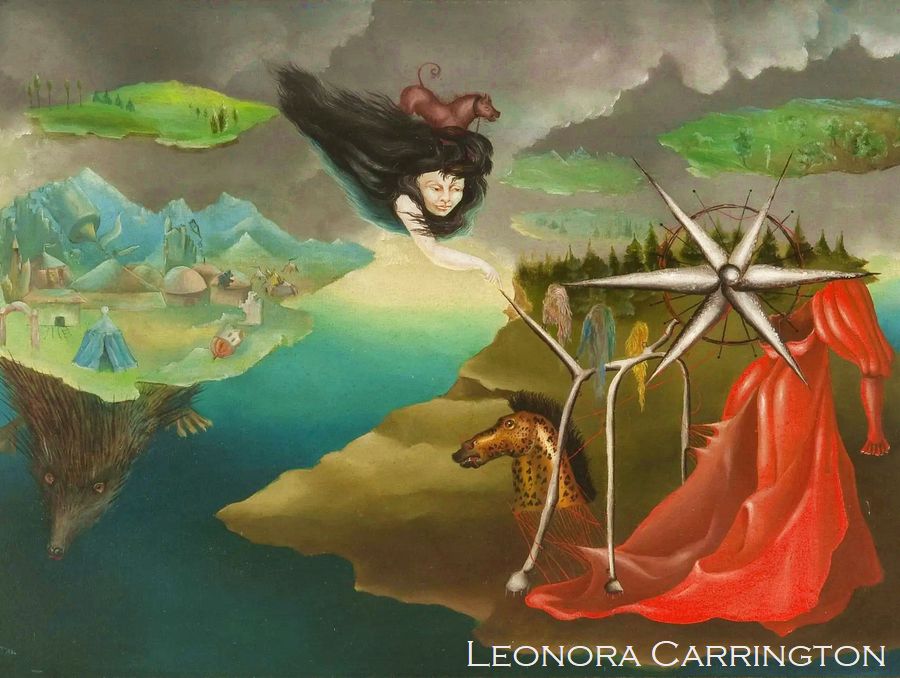 Leonora Carrington
Leonora Carrington (1917–2011) was a distinctive artist and writer whose work uniquely blended art, literature, and life through personal mythologies centered on metamorphosis, reinvention, and quest. Her unconventional life was shaped by exile, motherhood, and survival through 20th-century turmoil, with travel serving as a crucial element in her worldview.
Carrington's early career was significantly influenced by France, where she joined the Surrealist movement in 1937 with Max Ernst. Her journey subsequently led her through Spain, New York, and ultimately Mexico, where she cultivated a singular artistic and literary voice. She explored esoteric knowledge, ancient beliefs, and alternative ways of understanding, aiming to redefine women's historical roles. Her diverse influences spanned Renaissance art, Victorian literature, medieval alchemy, and magic, delving into themes of trauma, introspection, displacement, mythical femininity, and ecofeminism.
Key Aspects of Her Journey
. Early Influences
Her English childhood, rich with fairy tales, fostered a fantastical imagination. Early works featured imaginary, powerful feminine figures and fantastical creatures, hinting at themes of sisterhood and esoteric interests.
. Surrealist Period
In France, she collaborated with Max Ernst, creating a "total work of art" and writing her first literary pieces.
. Trauma and Exile
World War II led to separation from Ernst, her flight to Spain, a traumatic internment, and profound personal darkness that hermeticized her art. She later moved to New York, processing her trauma within the exiled Surrealist community.
. Life in Mexico
Settling in Mexico in 1942, she found a community of exiles. Her painting evolved significantly, influenced by creating a home and motherhood, incorporating dreamlike scenes and adopting techniques from Italian painting and Renaissance composition, imbued with introspective melancholy.
. The Heroine's Journey
Her life path is seen as a feminine interpretation of the "hero's journey," where she sought "inner maps" through myths, mystical traditions, and spiritual teachings.
. Luminous Darkness and Alchemy
Carrington integrated occultism, magic, tarot, and alchemy into her work, often obscuring meanings with playful narratives. The "alchemical kitchen" concept highlights her use of esoteric symbolism to explore temporal and spatial alteration, transforming domesticity into a space for female empowerment through magic and alchemy.
More information : museeduluxembourg.fr
Paris Exhibitions
LEONORA CARRINGTON
Leonora Carrington (1917–2011) était une artiste et écrivaine hors du commun dont l'œuvre mêlait de manière unique art, littérature et l'existence à travers des mythologies personnelles centrées sur la métamorphose, la réinvention et la quête. Sa vie peu conventionnelle a été façonnée par l'exil, la maternité et la survie à travers les troubles du XXe siècle, le voyage étant un élément crucial de sa vision du monde.
Les débuts artistiques de Carrington ont été fortement influencés par la France, où elle a rejoint le mouvement surréaliste en 1937 avec Max Ernst. Son parcours l'a ensuite mené à travers l'Espagne, New York, puis finalement le Mexique, où elle a cultivé une voix artistique et littéraire singulière. Elle a exploré le savoir ésotérique, les croyances anciennes et les modes alternatifs de compréhension, visant à redéfinir les rôles historiques des femmes. Ses influences trouvent leurs origines dans l'art de la Renaissance, la littérature victorienne, l'alchimie médiévale et la magie, abordant des thèmes tels que le traumatisme, l'introspection, le déplacement, la féminité mythique et l'écoféminisme.
Parcours
. Premières influences
Son enfance anglaise, riche en contes de fées, nourrissait une imagination fantastique. Les premières œuvres présentaient des figures féminines imaginaires et puissantes ainsi que des créatures fantastiques, évoquant des thèmes de sororité et d'intérêts ésotériques.
. Période surréaliste
En France, elle a collaboré avec Max Ernst, créant une « œuvre d'art totale » et écrivant ses premières œuvres littéraires.
. Traumatisme et exil
La Seconde Guerre mondiale a conduit à une séparation d'Ernst, à sa fuite vers l'Espagne, à un internement traumatisant, et à une profonde obscurité personnelle qui a "hermétisé" son art. Elle a ensuite déménagé à New York, où elle a traité son traumatisme au sein de la communauté surréaliste exilée.
. Vie au Mexique
S'installant au Mexique en 1942, elle a fondé une communauté d'exilés. Sa peinture a beaucoup évolué, influencée par la création d'un foyer et la maternité, incorporant des scènes oniriques et adoptant des techniques de la peinture italienne dont celles de la Renaissance, tout en étant imprégnées d'une mélancolie introspective.
. Le voyage de l'héroïne
Son parcours de vie est perçu comme une interprétation féminine du « voyage du héros », où elle cherchait des « cartes intérieures » à travers les mythes, les traditions mystiques et les enseignements spirituels.
. Obscurité lumineuse et alchimie
Carrington intégrait l'occultisme, la magie, le tarot et l'alchimie dans son œuvre, obscurcissant souvent les significations par des récits ludiques. Le concept de « cuisine alchimique » met en lumière son utilisation du symbolisme ésotérique pour explorer l'altération temporelle et spatiale, transformant la domesticité en un espace d'autonomisation féminine par la magie et l'alchimie.
Plus d'information : museeduluxembourg.fr
Art & Culture Paris