

Exposition - Exhibition
Mummies
History of a practice - Rituals - Scientific researchs
Until May 25, 2026
Musée de l'Homme - Paris
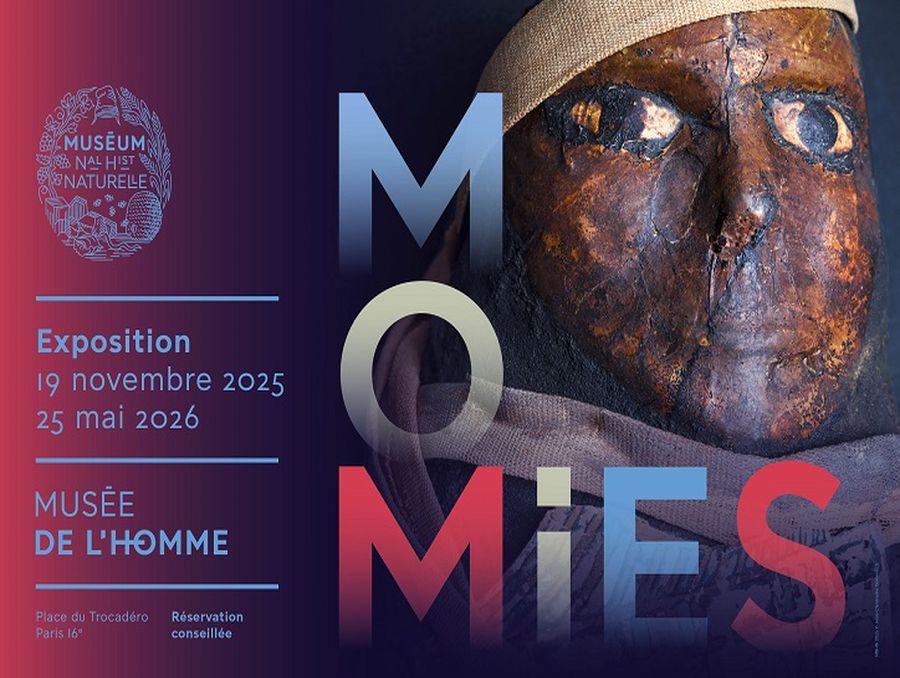 Mummies The exhibition explores the history and significance of mummification, a practice that extends far beyond ancient Egypt. While the image of mummies often evokes the pharaohs and pyramids, the reality is that mummification has been practiced across the globe for millennia. The exhibition delves into the lives of individuals who were intentionally mummified, examining the diverse reasons behind this practice and its cultural importance.
This panorama begins by challenging the common perception of mummies, which is often shaped by popular culture. It highlights that mummification dates back to 9,000 years ago, with the Chinchorro culture of South America. The exhibition showcases examples from various cultures, including the child found in France, the Guanche queen from the Canary Islands, and the "Chachapoya mummy" from the Peruvian Andes. These examples demonstrate the global reach and longevity of mummification.
This exploration invites visitors to understand the motivations behind mummification, which often involved preserving the body. It examines the techniques and rituals involved, from the specialists to the funerary objects. Through artifacts, illustrations, and educational displays, the exhibition reveals the variety of methods used to preserve the dead.
The exhibition also examines the history of Egyptomania and the role of museums in collecting and displaying mummies. It discusses the rise of archaeology and the impact of colonial powers on the acquisition of mummified remains. It highlights the ethical considerations surrounding the conservation and presentation of these remains, including provenance research and repatriation efforts.
Finally, the exhibition explores the scientific study of mummies, which provides insights into the lives of the deceased. Scientists use various techniques to reconstruct their lives, including their diet, health, and cause of death. It is a demonstration of how scientific research is helping to understand the lives of these individuals and their relationship with death.
More information : museedelhomme.fr
Momies
Cette exposition sur les momies, souvent associées à l'Égypte antique, élargit le sujet en explorant leur histoire, leur véritable portée et leur patrimoine à travers différentes cultures du monde. Bien que l'imaginaire collectif les encapsule dans des tombes égyptiennes classiques, les momifications remontent à environ 9 000 ans, avec des exemples comme ceux de la culture des Chinchorros, démontrant leur existence sur divers continents. Des figures emblématiques, telles qu'un enfant momifié en Auvergne, une reine guanche des Canaries et la momie Chachapoya, témoignent de la diversité des pratiques.
L'exposition examine aussi la volonté des individus à être momifiés, en soulignant leur place dans la société et l'importance de la préservation du corps face à sa décomposition naturelle.
Les techniques de momification, assorties de rites et processions funéraires codifiés, sont présentées à travers la position des corps (allongés, assis, accroupis) et l'utilisation d'objets funéraires. De plus, l'exposition évoque l'impact colonial du XIXe siècle sur la collecte de momies par les musées occidentaux et leurs évolutions éthiques récentes concernant la provenance et la conservation des restes humains.
Enfin, les recherches interdisciplinaires sur les momies fournissent des perspectives sur leurs vies antérieures, englobant leur mode de vie, leur apparence et leur santé avant la mort. En somme, cette exposition incite à réfléchir aux pratiques de momification et aux enjeux posés par leur existence dans le contexte muséal contemporain.
Plus d'information : museedelhomme.fr
Art & Culture Paris